How to Prepare a Rural Bank Business Plan (RBB) Under OJK Regulations
A practical guide to preparing a Business Plan (RBB) for rural banks (BPR) under POJK 15/POJK.03/2021 and SEOJK 24/SEOJK.03/2025: the legal basis, the 15 December deadline, the eleven mandatory components, a six-step manual preparation process, the most common mistakes and their penalties, and the signs that a rural bank has outgrown Excel.
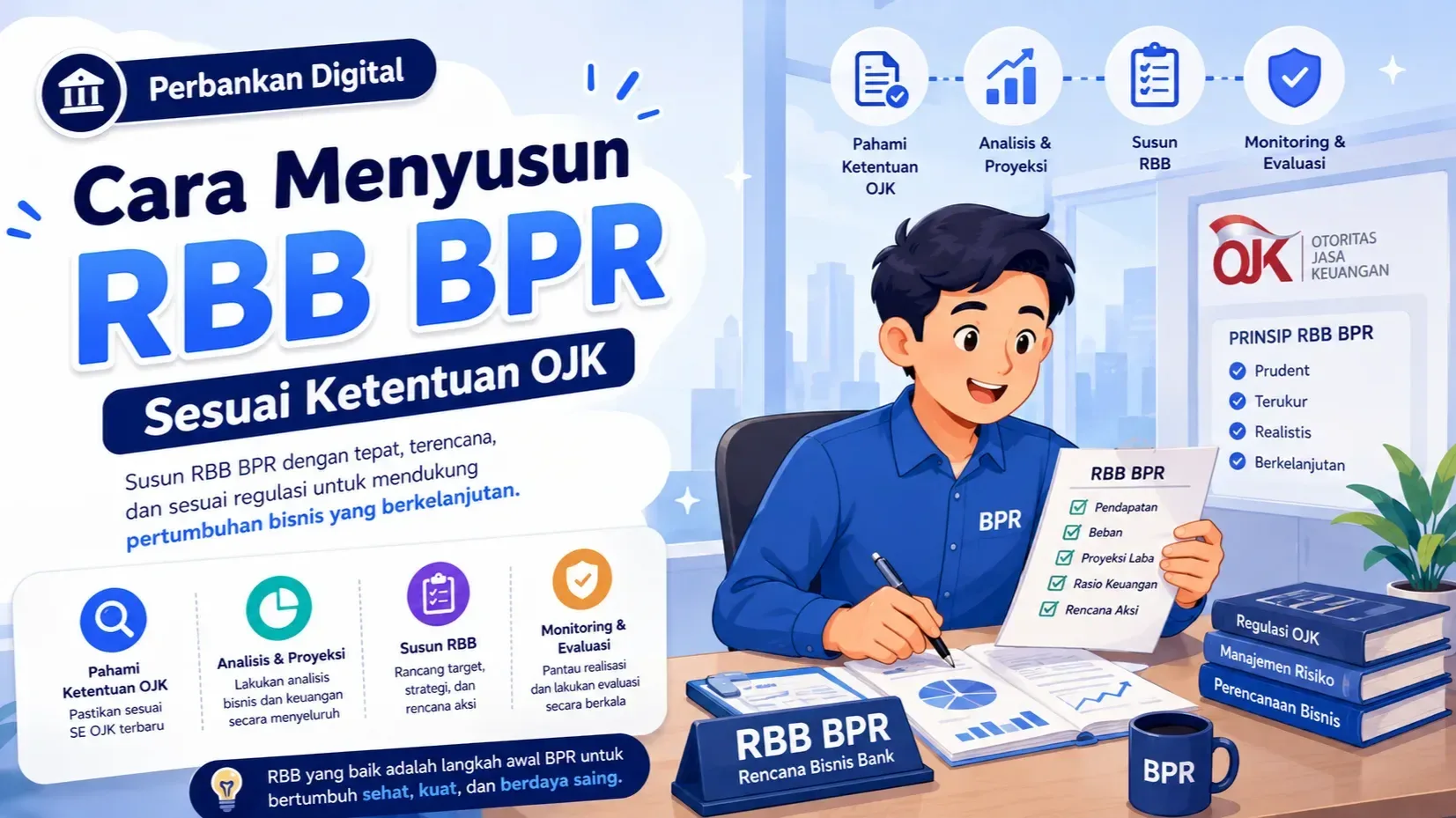
Every year-end, the directors and planning teams of rural banks (Bank Perekonomian Rakyat, or BPR) face the same task: preparing the bank's Business Plan, known in Indonesia as the RBB, for submission to the Financial Services Authority (OJK) no later than 15 December. The document is far from a formality. OJK uses the RBB as its reference for supervising the bank throughout the year, progress against it must be reported every six months, and late submission carries a daily fine. This article walks through how to prepare an RBB under the rules currently in force: the legal basis, who must submit and by when, the preparation steps, the most common mistakes, and the point at which a rural bank should stop relying on Excel.
What Is a Rural Bank Business Plan (RBB)?
The Business Plan (Rencana Bisnis Bank, or RBB) is a written document setting out the direction and policies for developing the bank's business. It covers business strategy, projected financial statements, target ratios, funding and lending plans, capital plans, and plans for developing information technology and human resources. The obligation is set out in OJK Regulation (POJK) No. 15/POJK.03/2021 on Business Plans of Rural Banks and Sharia Rural Banks, which replaced POJK No. 37/POJK.03/2016. The technical guidance was updated through OJK Circular Letter (SEOJK) No. 24/SEOJK.03/2025 on Business Plans of Rural Banks, in force since 20 November 2025.
Article 2 of POJK 15/2021 establishes three things: the RBB must be prepared realistically every year, it must be prepared by the Board of Directors and approved by the Board of Commissioners, and it must reflect the bank's short-, medium-, and long-term direction, including its vision and mission. Since Law No. 4 of 2023 on the Development and Strengthening of the Financial Sector (the P2SK Law) took effect, the Indonesian term for these banks changed from Bank Perkreditan Rakyat to Bank Perekonomian Rakyat, but the RBB obligation is unchanged.
Put simply, the RBB is the bank's written commitment to OJK about what it will achieve next year, and how.
Legal Basis for the RBB
- POJK No. 15/POJK.03/2021 on Business Plans of Rural Banks and Sharia Rural Banks. The principal regulation, governing the obligation to prepare a plan, its required contents, submission deadlines, amendments, implementation reporting, and sanctions. It revoked POJK No. 37/POJK.03/2016.
- SEOJK No. 24/SEOJK.03/2025 on Business Plans of Rural Banks. Technical guidance on reporting format and scope, issued on 13 November 2025 and revoking SEOJK No. 28/SEOJK.03/2021. Its key changes: the actual comparison position for projections moves from October to November, the Board of Commissioners is involved from the start of preparation, banks may engage professional services to help prepare the plan, and reports are submitted in txt and/or pdf format.
- POJK No. 9 of 2024 on the Implementation of Governance for Rural Banks and Sharia Rural Banks. In force since 1 July 2024, replacing POJK No. 4/POJK.03/2015. It governs the roles of the Board of Directors and the Board of Commissioners, including the limits on using professional services referred to in SEOJK 24/2025.
- POJK No. 34 of 2025 on the Provision of Information Technology by Rural Banks and Sharia Rural Banks. Promulgated on 17 December 2025 and effective one year after promulgation. The IT development and procurement plan that must be included in the RBB needs to be aligned with this regulation.
Under Article 7 of POJK 15/2021, the RBB must contain at least eleven components: an executive summary; business strategy and policies; projected financial statements; target ratios and financial items; a funding plan; a lending plan; a capital plan; an IT development and procurement plan together with a human resources development plan; a plan for new business activities; a plan for developing and/or changing the office network; and other information.
Who Must Submit, and When
Every rural bank and sharia rural bank must prepare an RBB each year, regardless of size. The Board of Directors prepares it and must explain it to shareholders and to every level of the organization. The Board of Commissioners approves it and must supervise its implementation.
- Submitting the RBB. No later than 15 December before the plan year begins (Article 19). For example, the 2027 RBB must reach OJK by 15 December 2026. OJK may ask the bank to present the plan it has submitted.
- Adjustments requested by OJK. If OJK requests an adjustment, the bank must submit it within 30 days of the date of OJK's letter (Article 20).
- Amendments on the bank's own initiative. Permitted where significant external or internal factors arise, only once, no later than the end of June of the current year, and taking effect no earlier than 30 days after submission (Article 21). SEOJK 24/2025 opens the possibility of more than one amendment at the supervisor's discretion.
- Business Plan Implementation and Supervision Report. Submitted semiannually, no later than one month after each half-year ends, meaning the end of July and the end of January (Article 22). This report combines the Board of Directors' account of actual results against the plan with the Board of Commissioners' supervisory findings, and is signed by the president director and the president commissioner.
All submissions are made through OJK's reporting system (Article 23).
One point that is easy to miss: SEOJK 24/2025 sets the actual comparison position at the November month-end. That leaves roughly two weeks between the final comparison data and the 15 December deadline. The framework of the plan must be finished well before then, with the November figures dropped in at the final stage.
Steps to Prepare the RBB
Below is the preparation process typically followed by rural banks that still rely on Excel. As an illustration, consider a bank with three branch offices and a two-person planning team that also handles finance.
1. Assemble historical data (start in October)
- Gather at least two to three years of Monthly Reports (Lapbul): balance sheet, income statement, and earning asset quality.
- Calculate the key ratios month by month: capital adequacy (KPMM), NPL, LDR, ROA, BOPO (operating expenses to operating income), and cash ratio.
- Pull the current year's actual results against the RBB up to the latest position, and set aside a column for the November position.
- In our example bank, each of the three branches sends its own Excel file, which head office then consolidates by hand.
2. Evaluate performance and the operating environment
- Compare this year's RBB targets with actual results, line by line. Record the cause of every deviation, since this also feeds the Implementation and Supervision Report.
- Summarize regional economic conditions, competition, and regulatory changes affecting the bank.
- Map internal strengths and weaknesses: credit quality, liquidity, human resources, and IT.
- Involve the Board of Commissioners from this stage for strategic direction, as SEOJK 24/2025 expects.
3. Set assumptions and build financial projections
- Set the assumptions: interest rates, growth in third-party funds, loan growth, cost of funds, and target NPL.
- Build monthly balance sheet and income statement projections for the next 12 months, consistent with those assumptions.
- Derive target ratios and financial items from the projections, not the other way around. Include the ratio of MSME loans to total loans, whose format is spelled out in SEOJK 24/2025.
- Prepare the capital plan, including any need for additional capital.
4. Prepare the supporting plans
- Human resources development: new hires, certifications, and mandatory training.
- IT development and procurement, aligned with POJK 34/2025.
- Office network changes and any new business activities.
5. Write the narrative and consolidate
- Write the executive summary and the business strategy and policies. The narrative must explain the numbers, not merely repeat them.
- Make sure the figures in the narrative, the projections, and the attachments match exactly. OJK is entitled to request a presentation, so every number must be defensible.
- Consolidate branch figures into bank-wide figures.
6. Approval, submission, and monitoring
- The Board of Directors reviews the full document and the Board of Commissioners gives its approval.
- Submit through OJK's reporting system before 15 December in the prescribed format, and keep proof of submission.
- Schedule monthly monitoring so that the semiannual Implementation and Supervision Report is not built from scratch.
Common Mistakes in Preparing the RBB, and What They Cost
- Historical figures retyped from the Monthly Reports. In our example bank, three branches over 36 months means hundreds of cells entered by hand. One wrong entry shifts every ratio, and the RBB no longer matches the data OJK already holds.
- Targets set without reference to actual results. Loans "up 20%", for instance, without looking at three years of lending trends. Article 2 of POJK 15/2021 requires the plan to be realistic, and large deviations must be explained in the semiannual report.
- Narrative copied from last year's plan. The numbers have changed, the narrative has not. The mismatch is obvious the moment OJK asks for a presentation or an adjustment.
- Branch figures consolidated incorrectly. Each branch's Excel layout differs, so some items are counted twice and others are missed.
- The plan is finished and then filed away. With no monthly monitoring, each half-year's Implementation and Supervision Report becomes a new project assembled in a hurry.
The penalties under POJK 15/2021:
- Late submission of the RBB, an adjustment, or the Implementation and Supervision Report: a fine of IDR 100,000 per day of delay up to a maximum of IDR 5,000,000 for banks with core capital below IDR 50 billion, or IDR 300,000 per day up to IDR 15,000,000 for banks with core capital of IDR 50 billion or more (Article 24). The submission obligation remains after the fine is imposed.
- An OJK-requested adjustment that is incomplete: a written warning, then a second warning if not corrected within 14 days, then a fine of IDR 3,000,000 or IDR 9,000,000 depending on core capital if still not corrected within a further 7 days (Article 25).
- An RBB not approved by the Board of Commissioners: a written warning, and if repeated, a possible downgrade of the bank's soundness rating by one level and/or temporary suspension of part of its operations (Article 6).
- Directors or commissioners who fail to implement or supervise the RBB: may be barred from serving as a main party (pihak utama) in a financial services institution (Article 6 paragraph 4).
When a Rural Bank Needs a System, Not Excel
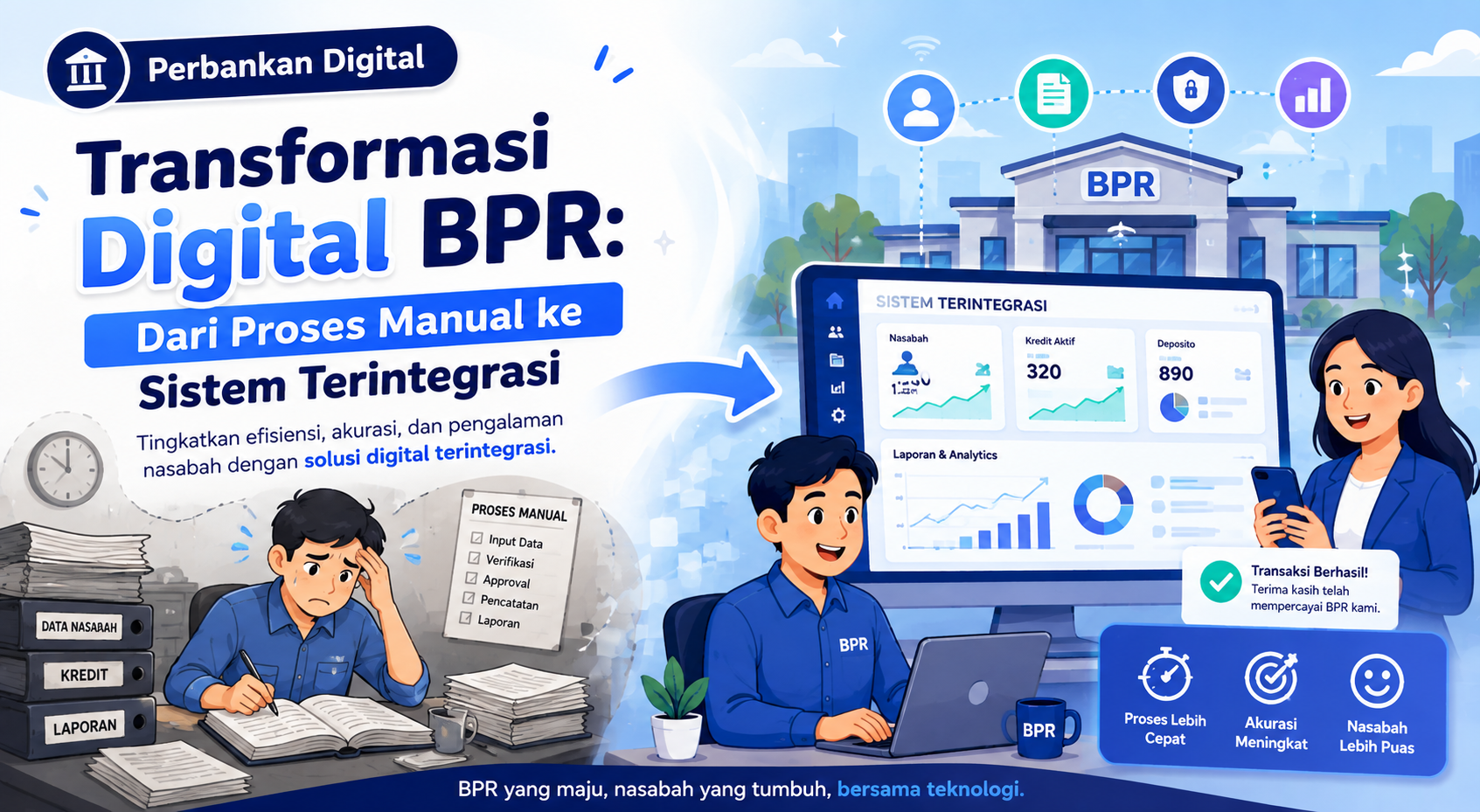
Excel remains adequate for a single-office bank with a stable team. A bank needs a system once any of the following is true: it has more than one branch, the person preparing the RBB also holds other duties, or the team has ever had to redo the work because the numbers did not reconcile. The shift of the comparison position to November adds to the case, because the window between final data and the deadline is now narrower.
The difference shows in five areas:
- Historical data. Manual: retyped from the Monthly Reports, month by month and branch by branch. With a system such as NAVISTA: the Lapbul/APOLO ZIP archive is imported automatically and immediately becomes three years of historical data.
- Branch consolidation. Manual: files merged one at a time, often in differing layouts. With a system: multi-branch consolidation runs automatically.
- Consistency of figures. Manual: the RBB, soundness rating (TKS), governance (GCG), and risk profile are each calculated in separate files. With a system: a single source of figures serves the RBB, TKS, GCG self-assessment, risk management, internal audit, and compliance.
- Narrative. Manual: written from scratch or copied from last year. With a system: an AI-assisted draft narrative is generated from the actual figures, ready for editing.
- Monitoring actual results. Manual: rebuilt every half-year. With a system: actuals are compared with targets continuously, so the Implementation and Supervision Report is simply generated.
NAVISTA is a planning, supervision, and governance platform for rural banks developed by PT Digital Amore Kriyanesia. Its working principle is simple: data enters once from the OJK archive and is then shared by every module, so the RBB, the soundness rating, and governance reports all start from the same numbers. NAVISTA does not replace the bank's core banking system. It works on top of the data the bank has already reported, at a price designed to be affordable for rural banks.
Closing
A sound RBB starts with accurate historical data, projections grounded in actual results, and a narrative that explains the numbers. The rest is scheduling discipline, because the 15 December deadline does not move.
If your team would like to see how this process runs when the Monthly Report data only needs to be imported once, contact the DAK team for a free consultation or to schedule a NAVISTA demo. We will listen to how your bank prepares its RBB today before recommending anything.
Sources
- POJK No. 15/POJK.03/2021 on Business Plans of Rural Banks and Sharia Rural Banks (in Indonesian)
- SEOJK No. 24/SEOJK.03/2025 on Business Plans of Rural Banks (in Indonesian)
- FAQ on SEOJK No. 24/SEOJK.03/2025 (in Indonesian)
- POJK No. 9 of 2024 on the Implementation of Governance for Rural Banks and Sharia Rural Banks (in Indonesian)
- POJK No. 34 of 2025 on the Provision of Information Technology by Rural Banks and Sharia Rural Banks (in Indonesian)