13 Rural Banks Closed in 2026: Causes and Lessons | DAK
OJK revoked the licenses of 13 rural banks (BPR and BPRS) by 1 September 2026, after 20 in 2024 and 7 in 2025. This article looks at the pattern behind the closures: the causes identified by OJK and LPS, the 18-month timeline from rehabilitation status to license revocation, the impact on depositors and the industry, and three warning signs a bank's directors and commissioners can check for themselves.
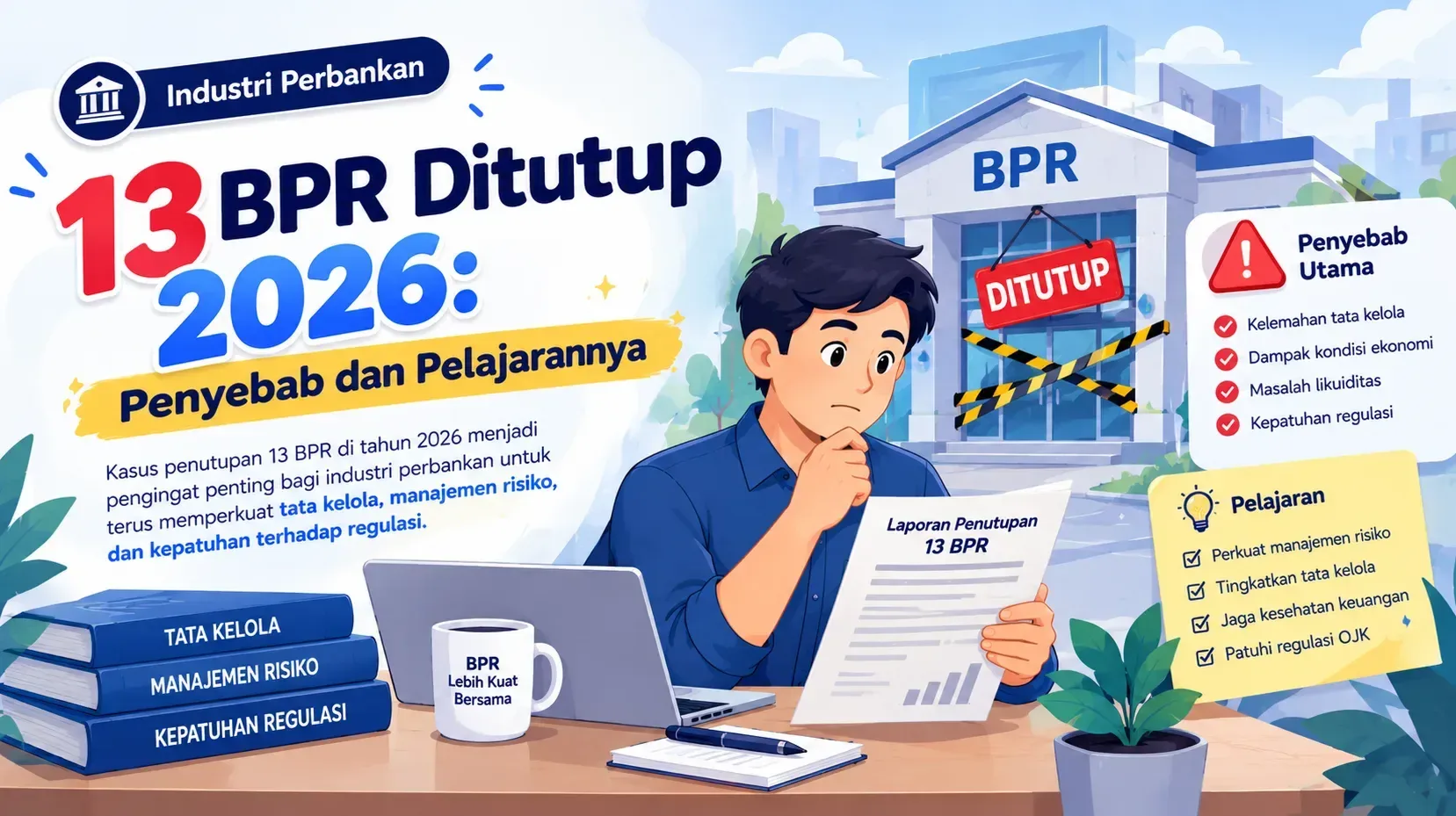
As of 1 September 2026, Indonesia's Financial Services Authority (OJK) has revoked the licenses of 13 rural banks (Bank Perekonomian Rakyat, or BPR) and sharia rural banks this year. The most recent was PT BPRS Gaido Indonesia in Cianjur, West Java. The figure follows 20 closures in 2024, the highest in two decades according to Tempo, and 7 in 2025. Analysts expect the wave to continue through the end of the year. This article is not a list of bank names. It is about the pattern: why these banks were closed, how a closure actually unfolds, and what banks that are still operating can learn from it.
Rural Bank Closures, 2024 to 2026
- 2024: 20 BPR and BPRS. According to the Deposit Insurance Corporation (LPS), the normal rate is only 6 to 7 closures a year. The 2024 figure was nearly three times that.
- 2025: 7 BPR and BPRS. Two of them were closed at the bank's own request.
- 2026, through 1 September: 13 BPR and BPRS. Among them were Perumda BPR Bank Cirebon (9 February), PT BPR Kamadana in Bali (February), PT BPR Sungai Rumbai in Dharmasraya, West Sumatra (7 April), PT BPR Ceper Permata Artha in Klaten (25 June), PT BPR Citra Bersada Abadi in Bekasi (19 August), and PT BPRS Gaido Indonesia in Cianjur (1 September). Kompas reports that 18 more BPR and BPRS are in liquidation.
Those numbers need to be read alongside another one: the industry itself is not collapsing. As of March 2026, total BPR and BPRS assets reached IDR 236.69 trillion, up 3.70 percent year on year. Lending grew 2.83 percent and third-party funds grew 3.16 percent. What is happening is not an industry crisis but a sorting: banks with weak governance are being removed, while the rest grow and consolidate.
The Cause Is Not Primarily Capital, but Governance
The most direct explanation comes from OJK itself. In January 2025, OJK's Chief Executive for Banking Supervision, Dian Ediana Rae, stated that most license revocations of BPR and BPRS stem from governance that was not properly implemented, ultimately leading to fraud.
From the LPS side, its Executive Director for Legal Affairs, Ary Zulfikar, pointed to three recurring gaps:
- Layered supervision that does not function. Employees hold authority without adequate control from above.
- Loans disbursed without assessment. Prospective borrowers collude with directors who have lending authority, followed by illegal payments to bank officials.
- Fictitious loans. Projects that never existed are created on paper, involving directors, staff, and committees.
The case of PT BPR Kamadana in Bali in February 2026 shows the typical combination: findings of fraud, breaches of prudential principles, a capital adequacy ratio (KPMM) below 12 percent, and a soundness rating of "Unsound." Eroded capital is the consequence, not the cause.
On capital, most rural banks have in fact cleared the bar. As of April 2024, OJK recorded 1,206 BPR and BPRS meeting the minimum core capital of IDR 6 billion. The latest rule, OJK Regulation No. 7 of 2026 on Minimum Capital Requirements and Minimum Core Capital for Rural Banks, in force since 30 June 2026, keeps that IDR 6 billion threshold and tightens the sanctions. Capital is the floor. What brings a bank down is what happens above that floor.
Anatomy of a Closure: The Warning Came 18 Months Earlier
No rural bank is closed overnight. OJK's press release on Perumda BPR Bank Cirebon lays out a sequence that has become the standard pattern:
- 2 August 2024. OJK placed the bank under "Rural Bank in Rehabilitation" status, because its KPMM was below 12 percent and its soundness rating was "Unsound."
- 1 August 2025. After a year's opportunity, rehabilitation efforts were judged to have failed. The status changed to "Rural Bank in Resolution."
- 3 February 2026. LPS decided not to rescue the bank and asked OJK to revoke its license.
- 9 February 2026. The license was revoked. LPS took over deposit payouts and liquidation.
Eighteen months. Throughout that time, the bank was still preparing monthly reports, assessing its own soundness rating, and submitting a business plan. In other words, the numbers that revealed the problem were on the desks of the directors and commissioners long before OJK's letter arrived. The question is not whether the data existed, but whether anyone read it honestly and acted.
What Happens to Depositors and to the Industry
For depositors, the mechanism is clear: deposits in rural banks are guaranteed by LPS under the applicable rules. Through the third quarter of 2025, LPS paid out IDR 385.41 billion in guarantee claims covering 37,724 accounts at 8 BPR and BPRS closed that year.
For the industry, the direction is consolidation. As of April 2026, 57 BPR and BPRS had merged into 18 banks, and more than 200 others were still in the merger process at OJK. The banks that survive will be larger, with more branches, and for exactly that reason will need supervision that does not depend on a single person.
Three Warning Signs a Rural Bank Can Check for Itself
From the pattern above, there are three simple questions that directors and commissioners can put to themselves:
- Are the figures reported to OJK the same as the figures used in internal meetings? When the monthly report, the soundness assessment, and the business plan are built from different files, small discrepancies can hide large problems.
- Can any loan be disbursed without a trail of layered approval? All three gaps cited by LPS begin with authority that leaves no trace.
- When did the Board of Commissioners last look at the monthly trend in KPMM and NPL, rather than only the year-end figure? Rehabilitation status begins with KPMM below 12 percent. The trend toward it is visible months in advance.
The Role of Systems: Not a Substitute for Integrity, but a Maker of Trails
Governance is ultimately about people. No software can replace honest directors and commissioners who ask questions. But a system changes two things: fraud becomes harder to commit because every decision leaves a trail, and problems are detected earlier because everyone is looking at the same numbers.
That is the principle behind NAVISTA, the planning, supervision, and governance platform for rural banks developed by PT Digital Amore Kriyanesia. Monthly report data is imported once from the OJK archive and then shared by the business plan, soundness rating, GCG self-assessment, risk management, internal audit, and compliance modules. The Board of Commissioners sees the same figures as the Board of Directors, from the same source, every month. Not to replace supervision, but to give supervision the right material.
Closing
Thirteen closures in eight months is not a number to ignore, but it is not a reason to panic either. The pattern behind it is consistent: weak governance, authority without a trail, and numbers that go unread. All of it can be fixed long before OJK's letter arrives.
If your bank would like to see how the same monthly report data can be used to monitor soundness, the business plan, and governance in one place, contact the DAK team for a free discussion. We will start with how your bank monitors its numbers today.
Sources
- Kompas, 2 September 2026: 13 BPR and BPRS Closed in 2026 (in Indonesian)
- OJK press release: License Revocation of Perumda BPR Bank Cirebon (in Indonesian)
- OJK press release: License Revocation of PT BPR Ceper Permata Artha (in Indonesian)
- Kompas, 19 February 2026: OJK Closes BPR Kamadana in Bali After Fraud Findings (in Indonesian)
- Antara: OJK on the Revocation of 20 BPR/S Licenses in 2024 (in Indonesian)
- Kompas, 29 December 2025: OJK Revoked 7 BPR Licenses in 2025 (in Indonesian)
- CNBC Indonesia, 7 January 2025: Most BPR Closures Caused by Fraud (in Indonesian)
- Kontan: BPR and BPRS Assets Grew 3.7% as of March 2026 (in Indonesian)
- CNBC Indonesia, 2 June 2026: OJK on the Growing Number of BPR Mergers (in Indonesian)
- Antara: OJK Says 1,206 BPR/BPRS Have Met the IDR 6 Billion Minimum Core Capital (in Indonesian)
- OJK press release: POJK No. 7 of 2026 on Minimum Capital and Core Capital for Rural Banks (in Indonesian)
- LPS: Institutional Report, Third Quarter 2025 (in Indonesian)